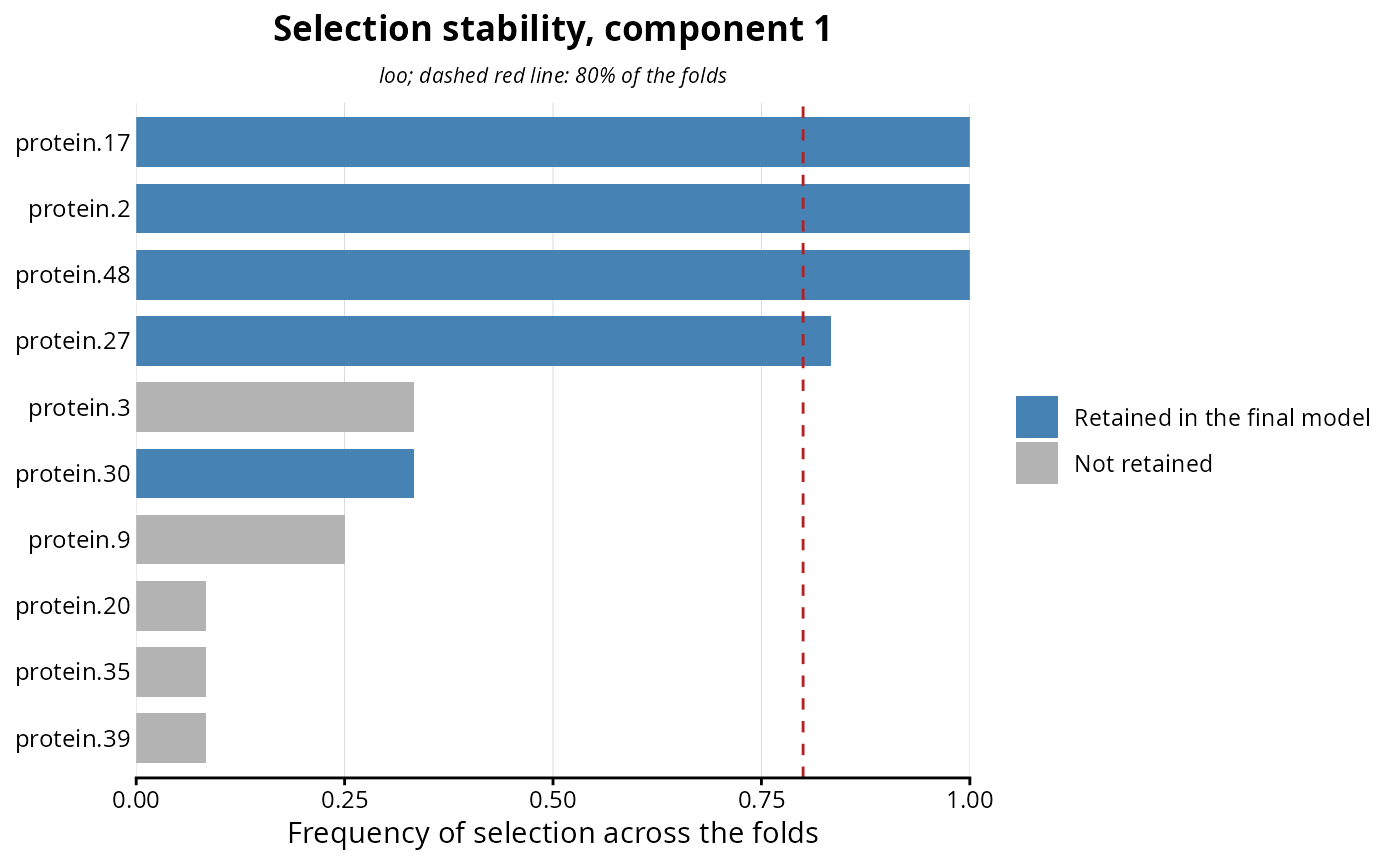
Plots how often each protein was re-selected across the cross-validation folds of a sPLS-DA.
# S3 method for class 'sPLSDA.stability'
plot(
  DEprot.sPLSDA.object,
  component = 1,
  n.proteins = 25,
  bar.color = "steelblue",
  other.color = "gray70",
  frequency.threshold = 0.8,
  protein.names.pattern = NULL,
  axes.text.size = 9,
  title = NULL
)
Arguments
- DEprot.sPLSDA.object
An object of class
DEprot.sPLSDA.- component
Numeric value indicating the component to display. Default:
1.- n.proteins
Numeric value indicating the maximum number of proteins to display. Default:
25.- bar.color
String indicating the color of the bars of the proteins retained in the final model. Default:
"steelblue".- other.color
String indicating the color of the bars of the proteins that were not retained in the final model. Default:
"gray70".- frequency.threshold
Numeric value (0-1) drawn as a dashed line, used as a visual reference for a stable selection. Default:
0.8.- protein.names.pattern
String indicating a pattern to be passed to gsub and removed from the protein names. Default:
NULL(no changes).- axes.text.size
Numeric value indicating the font size of the axis text. Default:
9.- title
String indicating the title of the plot (markdown annotation supported). Default:
NULL(automatic title).
Value
A ggplot object.
Details
The list of proteins returned by a sparse model is much less stable than it looks: on a small design, resampling the samples is often enough to swap half of it. A protein re-selected in nearly every fold is a marker worth following up; one appearing in a third of them is a property of the particular split, and the number written next to the bars is the only way to tell the two apart.
Proteins that were not retained in the final model but were frequently selected during the resampling are shown as well, since they are exactly the candidates that a slightly different dataset would have picked.
See also
Examples
# \donttest{
# the performances are estimated by resampling the samples: with 12 samples in 3 groups
# the leave-one-out scheme is the only one leaving enough samples in each fold
splsda <- perform.sPLSDA(DEprot.object = DEprot::test.toolbox$dpo.imp,
group.column = "condition",
keepX = 5,
validate = TRUE,
validation = "loo")
#> Estimating the classification performances by cross-validation...
plot.sPLSDA.stability(DEprot.sPLSDA.object = splsda, component = 1)
 # }
# }